
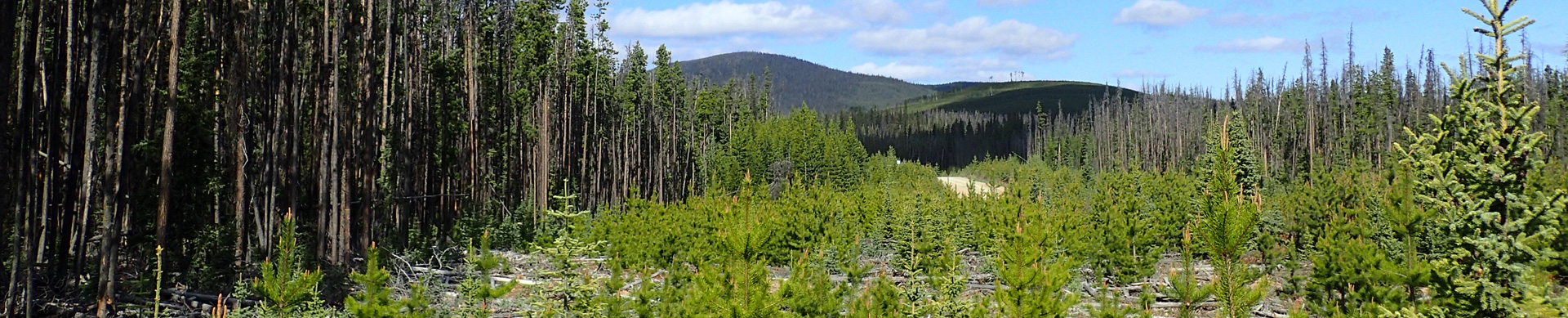
Vancouver, British Columbia--(Newsfile Corp. - November 19, 2026) - Tower Resources Ltd. (TSXV: TWR) ("Tower" or the "Company") is pleased to report assay results from 38 grab samples1 of boulders and outcropping or subcropping bedrock collected on the Rabbit North property in October within a 400-m-wide corridor straddling the fertile ENE structural trend between the Blue Sky Zone (see Fig. 1) and the 1001-grain gold-in-till anomaly previously identified 800 m to the northeast near the center of the Durand Stock (see November 3, 2025 press release).
Strong Au assays up to 15.1 g/t were obtained from four boulder samples along the Blue Sky structural trend (see Fig. 2), confirming that its fertility is sustained to the middle of the Durand Stock. A bedrock outcrop 250 m down-ice from the 1001-grain anomaly, apparently on the parallel Lightning trend, returned 8.06 g/t Au and 0.62% Cu supported by 0.79 and 0.31 g/t Au values from two nearby bedrock subcrops, effectively doubling the gold potential of the central part of the stock.
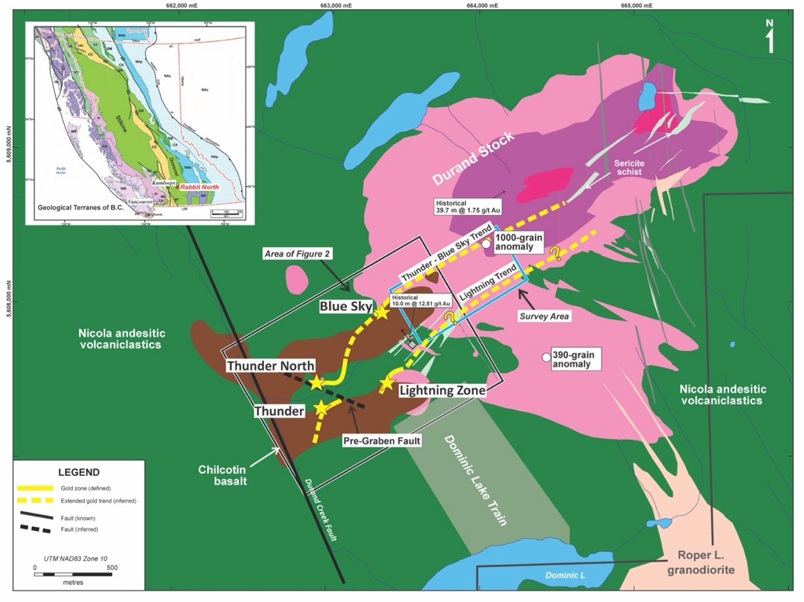
Figure 1 - Location of the Rabbit North property showing the current survey area relative to the geology of the central part and the major shear structures controlling Tower's gold discoveries. These shear zones are roughly coincident with more recent graben fault valleys that have been infilled by Chilcotin basalt flows. The yellow stars mark the locations of the main Au intersections in the initial discovery holes on the gold zones.
To view an enhanced version of this graphic, please visit:
https://images.newsfilecorp.com/files/5023/324830_figure1.jpg
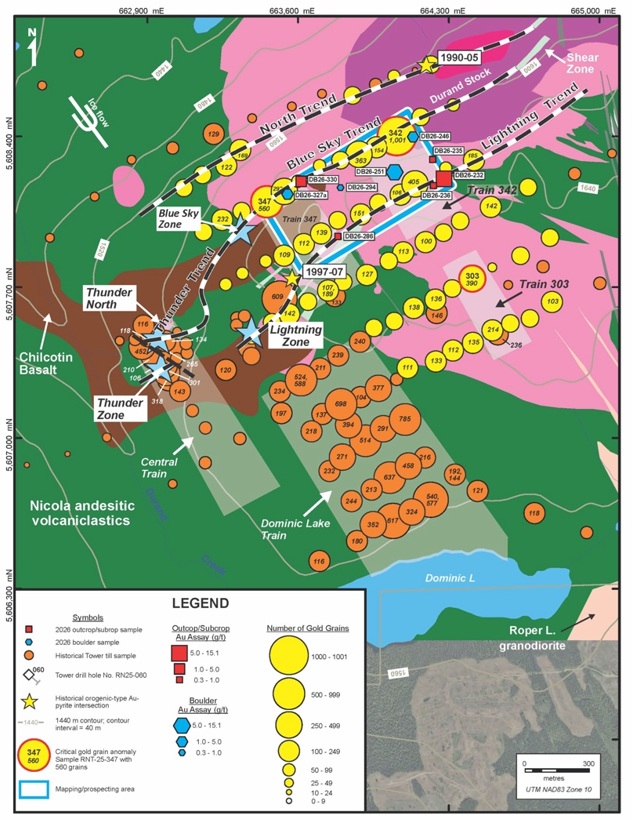
Figure 2 - Locations of significantly mineralized (>0.3 g/t Au) boulder and bedrock samples relative to the Blue Sky and Lightning trends and the gold grain content of the glacial till cover.
To view an enhanced version of this graphic, please visit:
https://images.newsfilecorp.com/files/5023/324830_figure2.jpg
Sampling Program
In early October, the Company performed three days of geological mapping and boulder prospecting in a 400 x 800 m area straddling the northeastern trajectory of the Blue Sky shear trend as inferred from the abundance of gold grains in the overlying glacial till (see Fig. 2). Information was recorded at 105 sites, including small, previously unmapped outcrops and rubbly subcrops that help constrain the trajectories of the fertile gold structures.
The possibility of finding intact mineralized boulders was limited because the tops of the shear zones were recessively oxidized to soft, clayey saprolite prior to glaciation. In addition, the westernmost 200 m of the shear trend is covered by younger Chilcotin basalt flows and was not glaciated. Nevertheless, 27 rusty boulders, many either stabilized by resistant quartz veins (see Fig. 3a) or reduced to a residual quartz boxwork (see Fig. 3b) by leaching of their original sulphides, were found and analyzed, along with three samples from outcropping bedrock and eight from subcrop.
Figure 3 (a) and (b) - Intensely oxidized boulders from preglacially saprolitized gold zones.
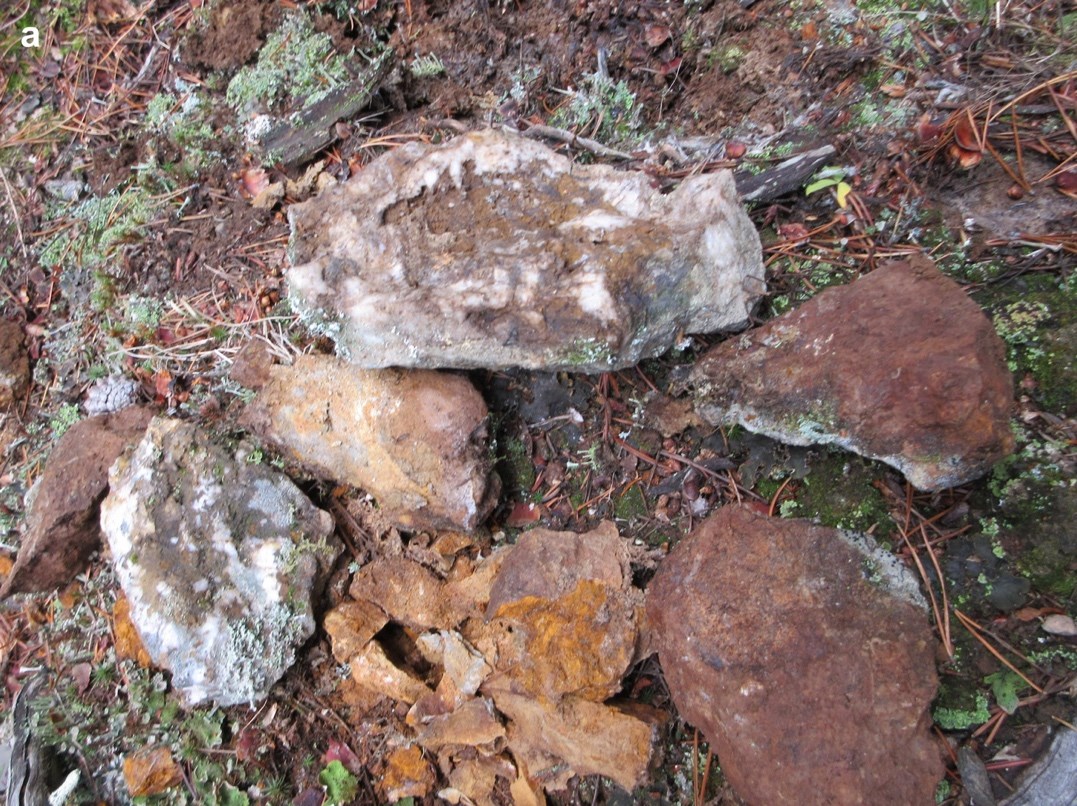
a) Boulder 246, 3.03 g/t Au, ~50 m down-ice from the Blue Sky Trend near the 1001 grain gold anomaly in the till. Vuggy, sulphide-depleted quartz veins in indecipherable, saprolitized host rock.
To view an enhanced version of this graphic, please visit:
https://images.newsfilecorp.com/files/5023/324830_41df4844d434480a_003full.jpg
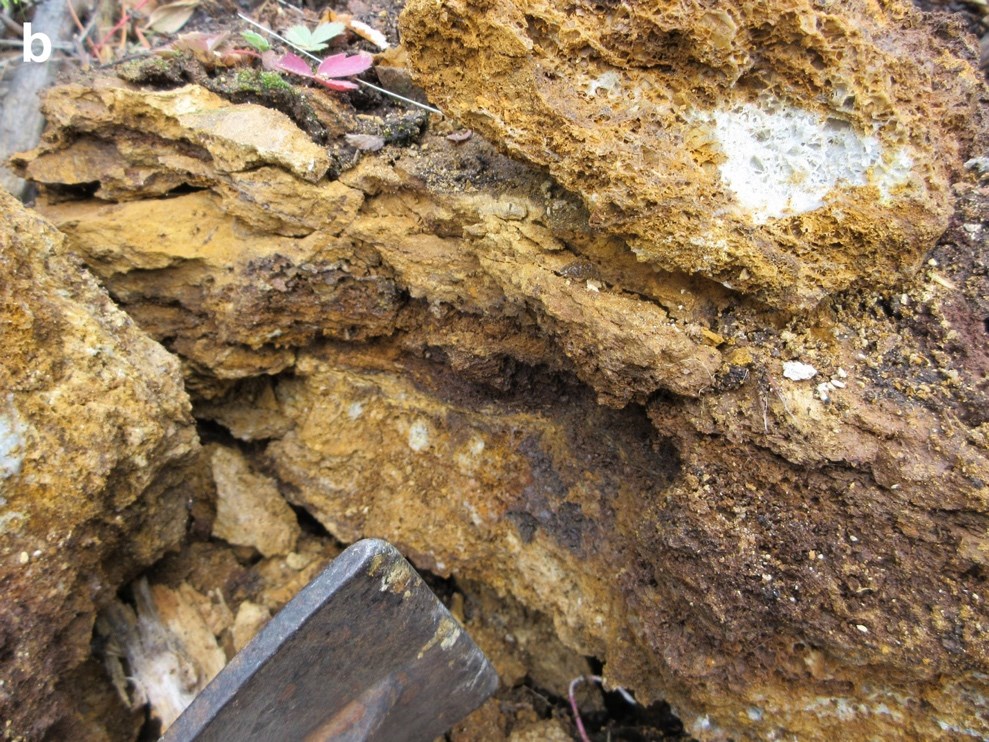
b) Bouder 294, 0.72 g/t Au, ~100 m down-ice from the Blue Sky Trend. Former sulphides have been completely leached out, leaving a honeycomb-like boxwork of resistate quartz. Original Au content may have been significantly higher.
To view an enhanced version of this graphic, please visit:
https://images.newsfilecorp.com/files/5023/324830_41df4844d434480a_004full.jpg
Au Results from Blue Sky Trend
Four distinctly auriferous boulders containing from 0.72 to 15.1 g/t Au (see Table 1) were found east of the Blue Sky Zone along the two untested segments of the structural trend that are not covered by Chilcotin basalt and thus were glaciated (see Fig. 2).
Boulder No. 327a with 2.40 g/t Au is roughly coincident with a 292-grain till gold anomaly astride the structural trend where it emerges from basalt cover ~100 m east along strike from the most easterly Blue Sky drill holes. A bedrock sample, No. 330 from an outcrop ~50 m further east, returned 1.86 g/t Au. Together these results imply that the Blue Sky Zone is at least twice its currently defined 150 m length.
The two most strongly mineralized of the other three boulders were found 500 m further east along the Blue Sky trend close to the peak 1001-grain gold anomaly. The sample from Boulder 246, ~50 from the till sample site, yielded 3.03 g/t Au and 73.5 g/t (2.14 oz/ton) Ag. The boulder contains residual quartz veins (see Fig. 3a) but is too oxidized to allow identification of the host rock. No bedrock exposures are present nearby. A smaller block of rusty diorite with vuggy, pyrite-depleted quartz veins (not photographed) found ~150 m down-ice from (southeast of) the Blue Sky trend, Boulder 251, yielded a highlight 15.1 g/t Au assay.
The fourth boulder, No. 294 midway along the Blue Sky trend (see Fig. 2), yielded only 0.72 g/t Au and 11.2 g/t Ag but is completely depleted of its formerly abundant sulphides (see Fig. 3b) and thus may be derived from a mineralized zone having a significantly higher primary Au content.
Au Results from Lightning Trend
Mapping and sampling of the available bedrock exposures along the southern edge of the survey area resulted in shifting the eastern trajectory of the Lightning structure to this area (see Fig. 2) from its previously inferred position ~300 m to the south.
One of the narrow, ENE trending features within the Durand Stock (grey lenses in Fig. 1) that were historically mapped as felsite dykes but are now known to be sheared and QSP altered diorite ± quartz-feldspar porphyry was sampled (No. 286 in Fig. 2) and returned 0.72 g/t Au, extending the Lightning Zone structural trend 600 m ENE from the drill defined gold zone. Approximately 500 m further ENE, near the middle of the stock, outcrop sample No. 232 yielded 8.06 g/t Au and 0.62% Cu, supported by 0.79 and 0.31 g/t Au, respectively, in Samples 235 and 236 from two nearby subcrops. This gold-enriched segment of the Lightning trend is just 250 m down-ice from and parallel to the segment of the Blue Sky trend with the strongest gold grain and boulder signatures, effectively doubling the resource potential of the central part of the Durand Stock.
| Sample No. | Type | Au (g/t) | Ag (g/t) | Cu (%) |
| DB26-232 | Outcrop | 8.06 | 4.2 | 0.62 |
| DB26-235 | Subcrop | 0.79 | 0.3 | NA |
| DB26-236 | Subcrop | 0.31 | 1.2 | NA |
| DB26-246 | Boulder | 3.03 | 73.5 | 0.05 |
| DB26-251 | Boulder | 15.1 | 4.1 | NA |
| DB26-286 | Outcrop | 0.72 | 11.2 | NA |
| DB26-294 | Boulder | 0.72 | 11.2 | NA |
| DB26-327a | Boulder | 2.40 | 2.5 | NA |
| DB26-330 | Outcrop | 1.86 | 2.2 | NA |
Table 1 - Analytical results for boulder and bedrock samples that assayed >0.3 g/t Au.
Summary and Next Steps
In just three days, the October mapping and boulder prospecting program produced three high-quality, drill-ready gold targets. All three are in the Durand Stock along extensions of the ENE trending structures that host the Company's Lightning, Thunder-Thunder North and Blue Sky discoveries in the Nicola volcanics west of the stock, greatly increasing the potential for discovering important new, near-surface gold zones and significantly expanding the resource base. The concentrated gold enrichment on both the Blue Sky and Lightning trends near the center of the stock is particularly encouraging.
Additional ENE trending features historically mapped as felsite dykes but presumed to be outcropping segments of the shear zones are present in the stock 500 to 1000 m ENE along strike from the area covered in the present survey (see Fig. 1), suggesting that the eastern part of the stock may be as prospective as the central part. Till sampling has not yet been performed down-ice from this area to confirm its inferred Au fertility. The high-resolution terrain maps pending from the Company's recent LIDAR survey should, however, be helpful for tracing the recessively saprolitized gold-bearing structures across the stock.
Methods and Qualified Person
The field mapping and boulder prospecting were led by Dane Bridge, MSc., P.Geo., a seasoned mineral exploration geologist who previously logged drill core from both the Lightning and Blue Sky Zones.
The boulder and bedrock samples were delivered directly to Activation Laboratories (ActLabs) in Kamloops, BC, a laboratory certified as ISO/IEC 17025 Accredited (Lab 790) by the Standards Council of Canada. QA/QC samples including blanks and standards were inserted regularly into the sample sequence at a ratio of approximately 1:20.
The samples were analyzed for Au by fire assay and ICP-OES and for Ag and 36 additional elements by ICP-OES using a four-acid, near-total digestion. Any over-limit (>5 g/t) Au analyses were repeated using the same fire assay procedure but with a gravimetric rather than ICP finish.
The technical content of this news release has been reviewed and approved by Stuart Averill, P.Geo., a director of the Company and a Qualified Person as defined by National Instrument 43-101.
About Tower Resources
Tower is a Canadian based mineral exploration company focused on the discovery and advancement of economic mineral projects in the Americas. The Company's key exploration assets, all in B.C., are the Rabbit North orogenic gold and porphyry copper-gold project located between the New Afton copper-gold and Highland Valley copper mines in the Kamloops mining district, the Nechako porphyry-associated gold-silver project near Artemis' Blackwater project and the More Creek epithermal gold project on the critical "red line" structural zone connecting the mineral deposits of the Golden Triangle.
On behalf of the Board of Directors
Tower Resources Ltd.
Joe Dhami, President and CEO
(778) 996-4730
www.towerresources.ca
Reader Advisory
This news release may contain statements which constitute "forward-looking information", including statements regarding the plans, intentions, beliefs and current expectations of the Company, its directors, or its officers with respect to the future business activities of the Company. The words "may", "would", "could", "will", "intend", "plan", "anticipate", "believe", "estimate", "expect" and similar expressions, as they relate to the Company, or its management, are intended to identify such forward-looking statements. Investors are cautioned that any such forward-looking statements are not guarantees of future business activities and involve risks and uncertainties, and that the Company's future business activities may differ materially from those in the forward-looking statements as a result of various factors, including, but not limited to, fluctuations in market prices, successes of the operations of the Company, continued availability of capital and financing and general economic, market or business conditions. There can be no assurances that such information will prove accurate and, therefore, readers are advised to rely on their own evaluation of such uncertainties. The Company does not assume any obligation to update any forward-looking information except as required under the applicable securities laws.
Neither TSX Venture Exchange nor its Regulation Services Provider (as that term is defined in policies of the TSX Venture Exchange) accepts responsibility for the adequacy or accuracy of this release.
1 Grab samples are selective by nature, unlikely to represent average grades, and may not represent true underlying mineralization.
To view the source version of this press release, please visit https://www.newsfilecorp.com/release/324830